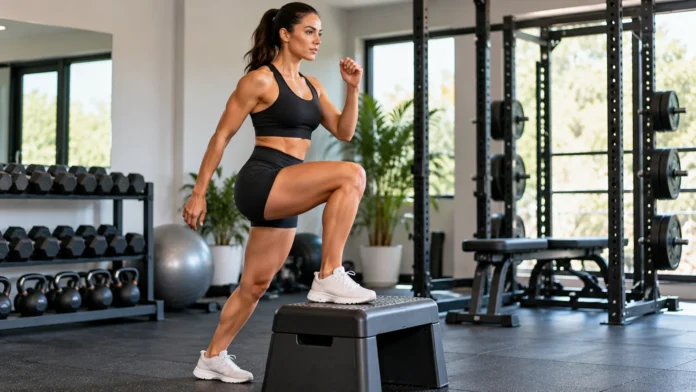

Step-ups are a practical lower-body exercise that can help improve leg strength, balance, coordination, and everyday mobility. This movement involves stepping onto an elevated surface and lifting your body upward using the working leg. Although step-ups appear simple, they engage several major muscle groups and can be adapted to suit different fitness levels and exercise goals.
Understanding the step ups muscles worked is important for anyone interested in building stronger legs or improving functional fitness. The exercise primarily targets the quadriceps and gluteal muscles while also recruiting the hamstrings, calves, and stabilizing muscles. Because step-ups resemble everyday movements such as climbing stairs, they offer practical benefits beyond traditional gym workouts.
This guide explains which muscles step-ups work, how the exercise affects lower-body strength, and the benefits of including it in a balanced fitness routine. You will also learn proper technique, common mistakes, beginner-friendly variations, and important safety considerations. Whether you exercise at home or in a gym, step-ups can be a useful addition to your workouts.
What Are Step-Ups? Meaning and Definition
Step-ups are a lower-body strengthening exercise performed by stepping onto a stable, elevated platform and bringing the body into a standing position. The movement requires coordinated action from several muscles around the hips, knees, and ankles. It is commonly included in strength training, functional fitness, and selected rehabilitation programs because it resembles everyday stair climbing.
During a traditional step-up, one foot is placed on the platform while the other remains on the ground. The working leg produces force to lift the body upward before the movement is reversed in a controlled manner. This process requires strength, balance, and coordination, making it a useful exercise for developing practical lower-body movement skills.
Step-ups are considered a unilateral exercise because each leg takes a leading role during its repetitions. Unlike exercises where both feet remain equally involved throughout the movement, step-ups allow each side to be trained individually. This characteristic can help individuals recognize differences in strength or control while developing a more balanced approach to lower-body conditioning.
What Muscles Do Step-Ups Work?
The primary muscles worked during step-ups are the quadriceps and gluteus maximus. These muscles generate much of the force needed to straighten the knee and extend the hip as the body rises onto the platform. Their contribution varies according to step height, movement technique, and the individual’s physical characteristics.
Step-ups also recruit the hamstrings, calf muscles, and smaller stabilizing muscles around the hips and ankles. These supporting muscles contribute to coordinated movement and help maintain balance throughout the exercise. The abdominal and trunk muscles also participate by helping control body position while weight shifts onto the working leg.
Although step-ups primarily target the lower body, they involve several muscle groups working together rather than isolating one muscle. This coordinated activity makes the exercise useful for developing functional strength. Understanding which muscles are involved can help individuals select appropriate variations and incorporate step-ups into a balanced exercise program.
Quadriceps: The Primary Muscles Used in Step-Ups
The quadriceps are a group of four muscles located along the front of the thigh. They include the rectus femoris, vastus lateralis, vastus medialis, and vastus intermedius. Their primary function is extending the knee joint, which is essential when pushing the body upward during a step-up.
As the working leg straightens, the quadriceps generate force to help lift body weight onto the platform. They also contribute to controlling knee bending as the body returns toward the starting position. This combination of lifting and controlled lowering allows the quadriceps to work through both concentric and eccentric muscle contractions.
Step-ups can help develop quadriceps strength as part of a well-rounded lower-body exercise routine. The amount of muscular demand depends on platform height, movement speed, and any resistance used. Choosing a manageable step height allows beginners to practice controlled movement without placing unnecessary demands on their knees.
Gluteus Maximus: How Step-Ups Strengthen the Glutes
The gluteus maximus is the largest muscle in the buttocks and plays an important role in hip extension. During step-ups, it helps move the body upward by extending the hip of the leading leg. This action works alongside the quadriceps to produce the force needed to reach the elevated surface.
Gluteal involvement can change depending on the height of the platform and the movement pattern. A higher step may increase the hip movement required, but it can also make balance and control more challenging. The goal should be comfortable, coordinated movement rather than selecting the highest possible platform.
The gluteus medius and gluteus minimus also contribute to maintaining pelvic stability during single-leg support. These muscles help manage side-to-side movement as the body shifts onto the elevated leg. Together, the gluteal muscles support hip control, functional movement, and lower-body strength during step-ups.
Hamstrings: Supporting Muscles During Step-Ups
The hamstrings are located along the back of the thigh and consist of the biceps femoris, semitendinosus, and semimembranosus. They contribute to hip extension and knee flexion during different activities. During step-ups, the hamstrings assist with hip movement and support coordination between the hip and knee joints.
Although the hamstrings participate in step-ups, they are generally not the primary muscles responsible for lifting the body. The quadriceps and gluteus maximus usually make larger contributions to the main upward movement. Hamstring activity can vary according to the exercise variation, body position, and individual movement mechanics.
Step-ups can complement exercises that more directly challenge the hamstrings, such as suitable hip-hinge and knee-flexion movements. Combining different lower-body exercises supports a broader range of muscle functions. This approach is useful because effective leg strength depends on coordination between multiple muscle groups rather than focusing exclusively on one area.
Calf Muscles and Ankle Stability in Step-Ups
The calf muscles, including the gastrocnemius and soleus, help control movement around the ankle during step-ups. They contribute to balance and assist with maintaining a stable foot position as body weight shifts. Their involvement becomes particularly noticeable when controlling the ankle during the lifting and lowering phases.
Proper ankle control supports smooth movement and helps distribute forces throughout the lower limb. When stepping onto a platform, the ankle adjusts as the knee and hip move through their ranges of motion. These coordinated changes allow the body to maintain balance without relying entirely on one joint or muscle group.
Step-ups can support functional ankle stability when performed with appropriate technique and a stable surface. However, they do not replace targeted calf or ankle exercises when specific strengthening needs exist. Individuals with recurring ankle instability or discomfort may benefit from professional guidance before progressing to more demanding variations.
Core Muscles and Balance During Step-Ups
The core muscles contribute to step-ups by helping maintain trunk stability while the body moves onto one leg. These muscles include the abdominal wall, obliques, and deeper structures supporting the spine. Their role is to control unnecessary movement rather than generate the primary lifting force.
As the body rises onto the platform, balance demands increase because support shifts toward the leading leg. The core works with the hip stabilizers to maintain an upright and controlled position. This coordination becomes especially important when stepping onto a platform without using external support.
Step-ups can therefore provide a useful balance challenge alongside lower-body strengthening. However, the amount of balance required depends on platform height, movement speed, and whether a stable hand support is available. Beginners should prioritize controlled movement and use assistance when necessary rather than deliberately making the exercise unstable.
Main Benefits of Step-Up Exercises
One of the main benefits of step-ups is improved lower-body strength through movements involving the hips, knees, and ankles. The exercise challenges several muscles simultaneously and can be adapted to different abilities. Regular practice may support everyday activities that require lifting body weight, such as climbing stairs or stepping onto raised surfaces.
Step-ups also help develop coordination and single-leg control because each repetition places greater responsibility on one leg. This characteristic makes them useful within balanced exercise routines designed to improve functional movement. Practicing both sides can help individuals develop awareness of differences in strength, stability, and movement quality.
Another advantage is convenience because basic step-ups require relatively little equipment. A stable, appropriately sized platform and sufficient surrounding space are often enough for beginners. The exercise can be performed at home or in a gym, making it accessible to people who prefer simple strengthening movements without complicated equipment.
Step-Ups for Glute and Leg Strength
Step-ups can contribute to stronger legs by challenging the quadriceps and gluteal muscles during repeated controlled movements. As these muscles adapt to appropriate resistance, they can become better prepared for everyday physical demands. Progress depends on consistency, suitable exercise difficulty, adequate recovery, and individual conditioning.
The exercise can be adjusted through platform height, repetition range, or external resistance when appropriate. However, increasing difficulty too quickly can compromise balance and movement quality. Beginners generally benefit from developing reliable bodyweight technique before experimenting with more demanding variations.
Step-ups work well alongside other lower-body exercises because they challenge strength through a practical movement pattern. Squats, bridges, and suitable hip-hinge exercises can provide complementary training benefits. A varied routine helps develop strength across different joints and movement patterns while avoiding unnecessary dependence on one exercise.
How to Perform Step-Ups With Proper Form
Begin by standing in front of a sturdy platform that allows comfortable movement without excessive knee or hip bending. Place one foot fully onto the surface and maintain a stable, upright posture. Choose a platform low enough that you can lift yourself smoothly without jumping or relying heavily on the trailing leg.
Press through the foot on the platform to raise your body into a controlled standing position. Keep your knee moving comfortably in line with the direction of your toes and avoid unnecessary twisting. Bring the trailing leg upward according to the selected variation while maintaining balance and avoiding sudden movements.
Lower yourself carefully by reversing the movement until the trailing foot returns to the floor. Avoid dropping quickly or allowing the working knee to collapse inward without control. Complete a comfortable number of repetitions before switching legs, and stop if the movement causes sharp pain, dizziness, or unusual instability.
Common Step-Up Mistakes to Avoid
A common step-up mistake is choosing a platform that is too high for the individual’s current strength and mobility. Excessive height may encourage awkward movement, unnecessary pushing from the trailing leg, or loss of balance. Beginning with a lower surface allows better control and helps establish a consistent movement pattern.
Another mistake is using momentum instead of controlled muscular effort to reach the top. Pushing forcefully from the lower foot can reduce the challenge placed on the leading leg and make the movement less predictable. Slowing the exercise slightly can improve awareness of body position and encourage smoother transitions.
Poor balance and uncontrolled lowering can also affect step-up quality. Leaning excessively, twisting the knee, or rushing through repetitions may create unnecessary discomfort. Using a stable support and reducing the difficulty are reasonable adjustments when technique becomes inconsistent, especially during the early stages of learning the exercise.
Different Step-Up Variations and Their Benefits
Basic bodyweight step-ups are suitable for many beginners because they allow individuals to practice movement without additional resistance. A low platform can make the exercise easier to manage while still engaging the quadriceps and gluteal muscles. Using a nearby hand support can also help people focus on comfortable leg movement.
Lateral step-ups involve approaching the platform from the side rather than directly from the front. This variation changes the movement pattern and places additional coordination demands on the hips and lower limbs. It may be useful for individuals who have already developed comfortable balance and control with standard step-ups.
Weighted step-ups introduce external resistance, typically through appropriate exercise equipment, when bodyweight repetitions become manageable. Added resistance can increase the strengthening challenge, but it also requires greater attention to stability and technique. Choosing a variation should depend on current ability, available equipment, and individual goals rather than simply selecting the most difficult option.
Step-Ups vs. Squats: Which Exercise Is Better?
Step-ups and squats are both useful lower-body exercises, but they challenge movement in different ways. Step-ups emphasize raising the body onto an elevated surface, with each leg taking a leading role. Squats generally involve coordinated bending and extending of both legs while the body moves downward and upward.
Both exercises recruit the quadriceps and gluteal muscles, although muscle activation and balance requirements differ. Step-ups introduce a stronger single-leg component, while standard squats allow both feet to remain supported throughout the movement. Neither exercise is automatically superior because their usefulness depends on individual fitness goals and physical abilities.
Combining step-ups and squats can provide variety within a balanced strength training routine. People who struggle with one movement may benefit from appropriate modifications or alternative exercises. Exercise selection should prioritize comfortable technique, gradual progression, and suitability for any existing mobility limitations or joint concerns.
Are Step-Ups Good for Knee Health?
Step-ups can support knee function by strengthening the quadriceps and other muscles involved in lower-body movement. Strong, coordinated muscles help manage forces acting on the knee during walking, climbing stairs, and similar activities. However, the exercise must be appropriate for the individual’s current strength, symptoms, and movement ability.
People with certain knee conditions may find high steps or demanding repetitions uncomfortable. Using a lower platform, reducing the range of movement, or providing hand support may make the exercise easier to tolerate. Pain should not be ignored, and exercise difficulty should be adjusted when discomfort increases.
Step-ups are sometimes included in rehabilitation programs because they resemble everyday functional movements. However, rehabilitation exercises should be selected according to the specific condition and professional assessment. Persistent knee pain, swelling, giving-way episodes, or recent injuries may require guidance from a qualified healthcare professional before performing step-ups.
How to Include Step-Ups in Your Workout Routine
Step-ups can be included in a lower-body workout or a general strengthening program alongside other suitable exercises. Beginners can focus on a manageable number of controlled repetitions with a low platform. The appropriate amount depends on individual conditioning, comfort, and how the exercise fits within the overall routine.
Rather than increasing repetitions simply to make the workout harder, prioritize consistent movement quality. Allow suitable recovery between challenging sessions and notice whether normal activities remain comfortable afterward. Progress can involve improved coordination and control before introducing additional resistance or a higher platform.
For a balanced routine, combine step-ups with movements that challenge other lower-body functions. Suitable exercises for the hips, hamstrings, calves, and core can complement the muscle activity involved in stepping. Enjoyable, sustainable training habits are generally more valuable than following an overly demanding routine that becomes difficult to maintain.
Conclusion
Step-ups are an effective lower-body exercise that engages the quadriceps, gluteus maximus, hamstrings, calf muscles, and stabilizing muscles. The movement helps develop strength and coordination through a pattern similar to climbing stairs. Understanding the muscles worked during step-ups can help individuals recognize their value within a balanced fitness routine.
The exercise offers benefits for functional strength, single-leg control, and everyday mobility when performed with appropriate technique. Proper platform selection, controlled movement, and gradual progression are important for comfortable participation. Different step-up variations provide flexibility, allowing individuals to select options that match their abilities rather than attempting unnecessarily difficult movements.
Whether performed at home or in a gym, step-ups can be a practical addition to regular physical activity. Combining them with other strengthening exercises supports well-rounded lower-body conditioning and movement confidence. By focusing on comfortable technique and individual needs, people can use step-ups to develop strength while maintaining a sustainable approach to fitness.
Frequently Asked Questions (FAQs)
What are the primary muscles worked during step-ups?
Step-ups primarily work the quadriceps and gluteus maximus. The hamstrings, calf muscles, hip stabilizers, and core also contribute to movement control, balance, and overall lower-body coordination.
Are step-ups better for glutes or quads?
Step-ups effectively engage both the glutes and quadriceps. Their relative contribution depends on platform height, movement technique, and individual anatomy, making them useful for balanced lower-body strengthening.
Do step-ups help strengthen the knees?
Step-ups can strengthen muscles that support knee movement and function. However, individuals with existing knee pain or injuries should use appropriate modifications and seek professional advice when necessary.
Can beginners do step-ups at home?
Yes, beginners can perform step-ups using a low, sturdy platform and nearby hand support if needed. Start with comfortable, controlled movements and avoid unstable furniture or excessive platform height.
What is the difference between step-ups and lunges?
Step-ups involve lifting the body onto an elevated surface, while lunges involve stepping into a position where both legs contribute to controlled lowering and rising. Both exercises strengthen the lower body.