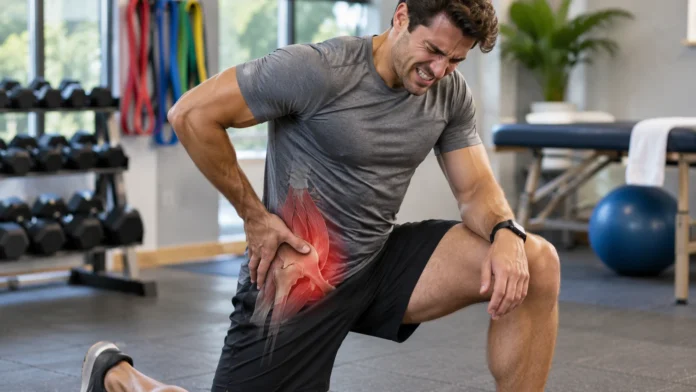

A strained hip flexor can make everyday movements like walking, climbing stairs, and getting out of a chair uncomfortable. This common muscle injury occurs when one or more muscles responsible for lifting the thigh become overstretched or damaged. It frequently affects athletes, runners, and people who perform repetitive movements, although anyone can experience a hip flexor strain.
Understanding hip flexor anatomy, muscle function, and common injury symptoms can help you recognize potential problems and make informed decisions about recovery. While mild strains often improve with appropriate rest and rehabilitation, more serious injuries may require professional evaluation. This guide explains how hip flexor muscles work, why strains develop, and which treatment approaches may support recovery.
What Is a Strained Hip Flexor?
A strained hip flexor is an injury affecting one or more muscles or tendons responsible for moving the thigh toward the upper body. It occurs when muscle fibers are stretched beyond their capacity or subjected to excessive force. The resulting injury may cause discomfort, tenderness, weakness, and difficulty performing movements that involve bending the hip.
Hip flexor strains can develop suddenly during activities such as sprinting, kicking, or changing direction quickly. They may also occur when repetitive movements place excessive demands on muscles without adequate recovery. The severity depends on how much muscle tissue is affected and whether the injury involves minor fiber damage or a more significant tear.
Some people experience only mild discomfort during certain movements, while others develop noticeable pain and reduced mobility. Symptoms may begin immediately after a particular activity or become more apparent afterward. Because other hip conditions can produce similar symptoms, persistent or severe discomfort should be evaluated by a healthcare professional.
Understanding Hip Flexor Anatomy
The hip flexors are a group of muscles that help move the thigh toward the abdomen. Their main components include the iliopsoas, rectus femoris, sartorius, and several muscles that assist with hip movement. These structures connect different parts of the pelvis, spine, and thigh, allowing the lower body to move efficiently.
The iliopsoas consists of the psoas major and iliacus muscles, which work together to produce powerful hip flexion. The psoas major originates from the lumbar spine, while the iliacus begins along the inner surface of the pelvis. Both attach to the lesser trochanter of the femur through a common tendon.
Other muscles contribute to hip flexion and support coordinated lower-body movement. The rectus femoris is part of the quadriceps group and crosses both the hip and knee joints. The sartorius and tensor fasciae latae also assist with certain hip movements, making the overall muscle group important for walking, running, and everyday mobility.
What Is the Main Function of the Hip Flexors?
The primary function of the hip flexors is to bring the thigh forward and upward toward the torso. This movement is known as hip flexion and occurs during many everyday activities. Walking, stepping onto a raised surface, climbing stairs, and moving from standing to sitting all involve coordinated activity from these muscles.
Hip flexors also contribute to movement during running and athletic activities. When a runner swings one leg forward, the hip flexor muscles help position the thigh for the next step. Their contribution becomes particularly important during sprinting, kicking, and movements that require repeated or powerful hip flexion.
The hip flexors work with surrounding muscles to support smooth movement and pelvic control. They interact with the abdominal muscles, glutes, and other structures around the hip joint. Healthy coordination between these muscle groups helps distribute movement demands and supports efficient lower-body function during physical activities.
Common Causes of a Strained Hip Flexor
Sudden movements involving forceful hip flexion are a common cause of hip flexor strains. Sprinting, kicking a ball, jumping, and rapid changes in direction can place substantial stress on these muscles. When the force exceeds what the muscle can tolerate, fibers may become damaged, resulting in pain and reduced strength.
Overuse can also contribute to hip flexor injuries, particularly when someone increases training intensity too quickly. Repetitive running, cycling, or sports practice may leave muscles fatigued without enough recovery between sessions. Fatigue can affect movement control and reduce the muscle’s ability to tolerate additional physical demands.
Previous injuries, inadequate conditioning, and sudden changes in activity can increase the risk of muscle strain. Limited mobility or strength deficits may contribute in some situations, although they do not guarantee an injury will occur. Understanding these factors can help people make safer decisions about exercise preparation, recovery, and gradual training progression.
Signs and Symptoms of a Strained Hip Flexor
Pain at the front of the hip or near the groin is one of the most common symptoms of a strained hip flexor. The discomfort may become more noticeable when lifting the knee, walking quickly, or climbing stairs. Some people experience a sudden pulling sensation during the activity that caused the injury.
Tenderness around the affected area may develop alongside stiffness and reduced movement. A more significant strain can sometimes cause swelling or bruising, although these symptoms do not occur in every case. Muscle weakness may also make it difficult to raise the leg comfortably or perform normal activities.
Symptoms vary according to injury severity, the affected muscle, and the movements involved. Mild strains may cause discomfort only during demanding activities, while more serious injuries can interfere with ordinary walking. Persistent pain, difficulty bearing weight, or worsening symptoms should prompt medical assessment to rule out other injuries.
Different Grades of Hip Flexor Strains
Healthcare professionals often describe muscle strains using a three-grade classification based on injury severity. This system helps explain the extent of muscle damage and guides general recovery expectations. However, symptoms alone cannot always determine the grade accurately, and clinical assessment may be necessary.
A grade 1 hip flexor strain involves relatively minor muscle fiber damage. People may notice mild tenderness and discomfort while retaining much of their normal strength and mobility. A grade 2 strain involves more extensive tissue injury and commonly produces greater pain, weakness, and difficulty performing certain movements.
A grade 3 strain refers to a complete muscle or tendon tear and is considerably more serious. It can cause significant weakness and substantial difficulty using the affected muscles. Severe injuries require prompt professional assessment because treatment may involve specialized rehabilitation or, in selected cases, surgical evaluation.
Where Does Hip Flexor Strain Pain Occur?
Hip flexor strain pain most commonly occurs toward the front of the hip, often near the groin. The exact location depends on which muscle or tendon has been affected. Some people experience discomfort deep within the hip region, while others notice tenderness closer to the upper thigh.
Pain associated with the rectus femoris may be felt toward the front of the upper thigh. Iliopsoas-related discomfort can sometimes feel deeper within the front of the hip. However, pain location alone is not reliable enough to identify the injured structure because several muscles, tendons, and joints occupy nearby areas.
Other medical conditions can produce discomfort in similar locations, including hip joint problems, tendon disorders, and certain groin injuries. These conditions may require different treatment approaches. A healthcare professional can assess movement, strength, tenderness, and medical history to help determine the source of persistent hip pain.
Hip Flexor Strain vs. Hip Flexor Tightness
Hip flexor tightness and a hip flexor strain can produce overlapping sensations, but they describe different problems. Tightness generally refers to a feeling of restricted movement or increased muscle tension. A strain involves actual injury to muscle or tendon tissue and may produce pain, tenderness, and weakness.
People who spend considerable time sitting may notice stiffness around the front of their hips. This feeling does not necessarily mean the muscles are injured or permanently shortened. Movement habits, physical conditioning, and other factors can influence how comfortable or restricted the hip feels during certain activities.
A hip flexor strain may become more painful when the affected muscle contracts forcefully or is stretched. Treating an acute strain as ordinary tightness and repeatedly forcing deep stretches may increase discomfort. When symptoms follow an injury, appropriate assessment and gradual rehabilitation are safer than assuming stretching alone will resolve the problem.
How Is a Strained Hip Flexor Diagnosed?
Diagnosing a strained hip flexor usually begins with a discussion of symptoms and the circumstances surrounding the injury. A healthcare professional may ask about recent athletic activities, sudden movements, previous injuries, and the location of discomfort. Understanding whether symptoms began suddenly or developed gradually can provide useful diagnostic information.
During the physical examination, the clinician may assess hip movement, muscle strength, tenderness, and walking ability. Certain movements can help identify which muscles may be affected and whether the pain is consistent with a strain. The examination may also look for signs suggesting another hip, groin, or lower-back condition.
Imaging tests are not necessary for every suspected hip flexor strain. However, ultrasound, X-rays, or magnetic resonance imaging may be recommended when symptoms are severe or the diagnosis is uncertain. These tests can help investigate significant muscle tears, bone injuries, or other conditions that require different medical management.
How to Treat a Strained Hip Flexor
Initial treatment for a mild hip flexor strain usually focuses on protecting the injured area and reducing activities that aggravate symptoms. Temporary modification of running, kicking, or other demanding movements may help prevent further irritation. Complete inactivity is not always necessary, but comfortable movement should remain within the limits recommended by a healthcare professional.
Applying a cold pack wrapped in a towel for short periods may help reduce discomfort during the early stages. The skin should be protected from direct contact with ice to avoid cold-related injury. Depending on individual health circumstances, a clinician may also recommend appropriate pain-relief medication or other supportive measures.
As symptoms improve, treatment generally shifts toward restoring comfortable movement, strength, and normal function. A physical therapist may recommend gradual exercises tailored to the injury and the person’s activity goals. Severe pain, significant weakness, or an inability to walk normally warrants medical evaluation rather than relying exclusively on home treatment.
Should You Stretch a Strained Hip Flexor?
Stretching may become useful during rehabilitation, but the timing and intensity matter. Immediately after a painful muscle strain, aggressive stretching can place additional stress on healing tissue. During the early stage, avoiding movements that reproduce sharp pain is generally more appropriate than attempting to force greater flexibility.
Once symptoms settle, gentle mobility work may help restore a comfortable range of motion. A physical therapist can identify suitable movements based on injury severity and recovery progress. Stretches should feel controlled and tolerable rather than producing sharp discomfort or increasing symptoms afterward.
Stretching alone does not address every aspect of hip flexor recovery. Muscles also need sufficient strength and coordination to handle normal movement demands. A balanced rehabilitation approach may include mobility work, progressive strengthening, and gradual exposure to everyday or athletic activities as tolerated.
Exercises That May Support Hip Flexor Recovery
Rehabilitation exercises can help restore muscle function after a hip flexor strain, but they should match the stage of healing. Early activities may involve gentle, pain-limited movement rather than demanding resistance exercises. The goal is to maintain comfortable mobility while avoiding unnecessary stress on injured tissues.
As recovery progresses, a healthcare professional may introduce controlled hip flexion exercises and strengthening activities for surrounding muscles. Exercises involving the glutes, abdominal muscles, and lower limbs can support overall movement coordination. Resistance and repetitions should increase gradually according to symptoms, strength, and individual rehabilitation goals.
Later rehabilitation may include walking progressions, balance work, and sport-specific movements for people returning to athletic activities. Runners and athletes may eventually need to rebuild tolerance for faster movements and changes in direction. These activities should be introduced carefully, especially when the original strain involved high-speed or forceful muscle contractions.
How Long Does a Strained Hip Flexor Take to Heal?
Hip flexor strain recovery depends on injury severity, overall health, and the demands placed on the affected muscle. Mild strains may improve substantially within a few weeks, while more significant injuries can require several weeks or months. Individual recovery timelines vary, making it difficult to predict healing based only on early symptoms.
A person with a minor strain may regain comfortable walking before returning to running or demanding exercise. More serious injuries often require structured rehabilitation to restore strength and movement control. Returning too quickly to painful activities can aggravate symptoms and interfere with a steady recovery process.
Recovery should be judged through functional improvement rather than time alone. Important signs include comfortable daily movement, improving strength, and the ability to perform relevant activities without significant pain. A clinician or physical therapist can help determine whether the affected muscles are ready for more demanding exercise or sports participation.
Can You Walk With a Strained Hip Flexor?
Many people with mild hip flexor strains can continue walking, although certain movements may feel uncomfortable. Short, comfortable walks may be appropriate when they do not worsen symptoms. However, walking ability depends on the severity of the injury and whether other structures around the hip are involved.
If walking causes a noticeable limp or increasing pain, reducing activity and seeking professional advice may be necessary. A significant injury may require temporary support or specific movement restrictions. Trying to push through substantial pain can make it harder to recognize when the injured area needs additional protection.
As healing progresses, normal walking can provide a useful indication of improving function. Comfortable movement on level ground usually returns before more demanding activities such as running or jumping. Persistent difficulty bearing weight should not be dismissed as a routine strain symptom, particularly following a fall or other injury.
How to Prevent Future Hip Flexor Strains
Preventing hip flexor injuries involves preparing muscles for physical activity and managing training demands appropriately. Gradually increasing exercise intensity gives the body time to adapt to new movement requirements. Sudden changes in running speed, training volume, or athletic workload can increase the likelihood of excessive muscle stress.
A balanced exercise routine should include strengthening activities for the hips, legs, and surrounding muscles. Warm-up movements can help prepare the body for demanding activities, especially sports involving sprinting or kicking. Adequate recovery between challenging sessions also supports muscle adaptation and reduces the effects of accumulated fatigue.
Movement quality, strength, and individual conditioning deserve attention when returning from a previous injury. Athletes may benefit from rehabilitation plans that gradually rebuild their ability to tolerate high-speed movements. Although no prevention strategy eliminates every injury risk, consistent preparation and sensible activity progression can support healthier muscle function.
When Should You See a Doctor for Hip Flexor Pain?
Medical assessment is recommended when hip pain is severe, persistent, or interferes with ordinary activities. Significant weakness, noticeable swelling, or difficulty walking may indicate a more serious muscle injury or another condition. A clinician can evaluate symptoms and determine whether additional testing or specialized rehabilitation is appropriate.
Seek urgent medical care after a significant injury if you cannot bear weight, experience severe pain, or notice an obvious deformity. Fever, marked redness, or rapidly worsening symptoms also deserve prompt evaluation. These signs may suggest problems that should not be treated as a simple muscle strain.
If symptoms do not improve with appropriate activity modification or repeatedly return during exercise, a healthcare appointment is advisable. Recurring discomfort may reflect incomplete rehabilitation, continued overload, or another hip condition. Early evaluation can help clarify the cause and establish a safer plan for returning to normal activities.
Key Facts About Hip Flexor Health and Function
Hip flexors are essential for many movements that people perform throughout the day. They help lift the thigh, contribute to walking and running, and support coordinated movement around the pelvis. Because several muscles participate in hip flexion, problems affecting one structure can influence how surrounding muscles and joints function.
A strained hip flexor is different from ordinary muscle soreness or stiffness. It involves injury to muscle or tendon tissue and may require temporary activity changes and progressive rehabilitation. The severity can range from relatively minor fiber damage to a complete tear, with recovery needs varying accordingly.
Maintaining healthy hip flexors involves appropriate strengthening, comfortable mobility, and sensible management of physical activity. Persistent pain should not automatically be attributed to tight muscles or poor posture. Understanding the anatomy and function of these muscles helps people recognize potential problems and seek appropriate care when necessary.
Conclusion
A strained hip flexor occurs when muscles or tendons involved in lifting the thigh become overstretched or damaged. The injury can cause pain near the front of the hip, muscle tenderness, weakness, and difficulty moving comfortably. Understanding hip flexor anatomy and function helps explain why these symptoms can interfere with walking, running, and everyday activities.
Most mild hip flexor strains can improve through appropriate activity modification and gradual rehabilitation. More serious injuries may require additional medical assessment and a structured recovery program. Restoring comfortable movement, rebuilding strength, and allowing sufficient healing time are important steps before returning to demanding physical activities.
Recognizing warning signs and avoiding premature return to exercise can help support recovery. Persistent pain, worsening weakness, and difficulty bearing weight deserve professional attention. With an individualized treatment approach and sensible activity progression, many people can regain normal hip function and reduce their risk of future muscle strains.
Frequently Asked Questions
What does a strained hip flexor feel like?
A strained hip flexor often causes pain or tenderness at the front of the hip or near the groin. Discomfort may increase when lifting the knee, climbing stairs, running, or stretching the affected muscle.
How do you heal a strained hip flexor quickly?
Recovery involves reducing painful activities, using appropriate early symptom management, and gradually restoring movement and strength. Avoid forcing stretches or returning to intense exercise too soon, as healing time depends on injury severity.
Can you walk with a strained hip flexor?
People with mild hip flexor strains can often walk if movement remains comfortable. However, significant pain, limping, or difficulty bearing weight suggests the need for medical assessment and possible activity restrictions.
How long does a hip flexor strain take to recover?
Mild strains may improve within a few weeks, while more significant injuries can require several weeks or months. Recovery depends on the extent of tissue damage, rehabilitation progress, and individual health factors.
Is hip flexor pain always caused by a muscle strain?
No, pain at the front of the hip can also result from tendon conditions, hip joint problems, bone injuries, or referred pain. Persistent or severe symptoms should be evaluated to identify the underlying cause.